
Hilton Honors American Express Card Canada Review
Marriott has had the Canadian hotel credit card market to itself for years. Not anymore. The new Hilton Honors American Express Card hands you Hilton Gold status the moment you’re approved and pays out well on everyday purchases. The catch is that its most valuable rewards only show up once you’ve put a lot of spending on the card.
I went through the details to see how it measures up against the Marriott Bonvoy American Express Card, where each card has the edge, and which type of traveller will get the most out of Hilton’s offering.
The two cards side by side
| Hilton Honors American Express Card | Marriott Bonvoy American Express Card | |
|---|---|---|
| Annual fee | $150 | $120 |
| Welcome bonus | 60,000 points after $3,000 in spending in the first three months, plus 10,000 points after $500 in spending in month 13, plus a Free Night Reward | 65,000 points after $3,000 in spending in the first three months, plus 10,000 points after $500 in spending in month 13 – When using a referral link |
| Hotel spending | 6 points per dollar at Hilton properties | 5 points per dollar at Marriott properties |
| Gas, groceries and dining | 4 points per dollar (in Canada) | 2 points per dollar |
| Everything else | 2 points per dollar | 2 points per dollar |
| Status with the card | Gold | Silver |
| Spend-based status | Diamond at $40,000 a year | Gold at $30,000 a year |
| Annual reward | 50,000 points after $12,000 in calendar-year spending | Free night worth up to 35,000 points on renewal |
The welcome bonus is where Hilton makes its first impression. Spending $3,000 in your first three months gets you 60,000 points, which most people can manage with regular household spending. The remaining 10,000 points require $500 in spending in month 13, which means you’ll need to keep the card past your first anniversary and pay the $150 fee twice. I value one Hilton Honors point at 0.5 cents, so the full 70,000 points are worth about $350 before you factor in the Free Night Reward. Signing up for the card is a no-brainer in the first year.
Instant Gold status is the headline perk
The strongest part of Hilton’s pitch is what you get without doing anything at all. Every cardholder receives Hilton Honors Gold status, and the best part of Gold is the daily food and beverage credit or continental breakfast, depending on the property. Add in room upgrades when available, and it’s a benefit that pays off whether you’re travelling for work or with the family.
That matters because Hilton has fewer hotels worldwide than Marriott, so it needs a reason to win your loyalty. Status is that reason. Marriott’s card only comes with Silver status, and beyond a late checkout request, there isn’t much to it. Even if you spend $30,000 a year to unlock Marriott Gold, you still won’t get breakfast.
| Status level | How you get it with the card | Key perks |
|---|---|---|
| Hilton Honors Gold | Automatic | 80% points bonus on stays, food and beverage credit or breakfast, room upgrades when available |
| Hilton Honors Diamond | Spend $40,000 in a calendar year | 100% points bonus on stays, executive lounge access, food and beverage credit or breakfast, upgrades up to a one-bedroom suite when available |
| Marriott Bonvoy Silver Elite | Automatic | 10% points bonus on stays, priority late checkout |
| Marriott Bonvoy Gold Elite | Spend $30,000 in a calendar year | 25% points bonus on stays, 2 p.m. late checkout, enhanced room upgrades |
Then there’s Diamond, Hilton’s top tier, which the card unlocks once you spend $40,000 in a calendar year. That’s a big number, and most people won’t come close. But very few credit cards in Canada let you buy your way into top-tier hotel status. If you run business expenses through your personal card or have a major purchase coming up, it’s within reach, and the executive lounge access can easily cover your breakfast, snacks and evening drinks on a longer stay.
50,000 points a year vs. a free night
Hilton’s yearly reward is where the card will divide people. Each calendar year you spend $12,000, you get 50,000 bonus points. Spend less, and you get nothing. Marriott takes the opposite approach, handing you a free night worth up to 35,000 points every time you renew, regardless of how much you’ve spent.
Where Hilton pulls ahead is in how you can use the reward. Marriott’s free night is good for one night at one property, and even with the optional 25,000-point top-up, it maxes out at 60,000 points. Hilton’s points behave like any other points in your account. You can stretch them over a multi-night stay or pool them with points you’ve earned elsewhere to book somewhere like the Waldorf Astoria or Conrad.
Timing is the other difference. A Marriott free night certificate expires a year after it’s issued, so if travel plans fall through, the reward disappears. Hilton’s points have no deadline as long as your account sees some activity at least once every 24 months. You can save them up across several years for a bigger trip.
| Hilton annual bonus | Marriott free night | |
|---|---|---|
| What you get | 50,000 points | Free night worth up to 35,000 points |
| Spending required | $12,000 in a calendar year | None |
| Maximum value | Unlimited, combined with your other points | 60,000 points with the 25,000-point top-up |
| How you can use it | Any points booking | One night at one property |
| Expiry | No set expiry with account activity every 24 months | One year from when it’s issued |
The math comes down to your spending. If you’ll fall short of $12,000, Marriott wins this round easily. If you’ll clear it, the two rewards are worth about the same on paper (roughly $250 in Hilton points vs. up to $245 for Marriott’s free night, but Hilton wins due to the flexibility.
Breaking down the earn rates
Status and annual rewards get the attention, but what you earn on every purchase is what builds your points balance over time.
The headline numbers favour Hilton, but they don’t tell the whole story because a Hilton point is worth less than a Marriott point. The generally accepted value is 0.5 cents per Hilton Honors point and about 0.7 cents per Marriott Bonvoy point. Once you account for that, here’s what each card actually returns.
| Spending category | Hilton card | Marriott card |
|---|---|---|
| Hotel stays | 6 points per dollar (3%) | 5 points per dollar (3.5%) |
| Gas, groceries and dining | 4 points per dollar (2%) | 2 points per dollar (1.4%) |
| Everything else | 2 points per dollar (1%) | 2 points per dollar (1.4%) |
Marriott has the higher return on hotel stays and on everything that falls outside a bonus category. Hilton’s advantage is gas, groceries and dining, where it returns 2% vs. 1.4%. For most Canadian households, those are among the largest monthly expenses.
Note that both cards charge FX fees, so they’re not great when travelling unless you’re using them at Hilton or Marriott hotels where the multiplier is much higher.
That said, the Amex Cobalt still beats the Hilton card when it comes to earning on groceries and dining.
Putting it to the test
To compare the cards in a realistic scenario, I used a cardholder who spends $24,000 a year: $2,000 on hotels, $10,000 on gas, groceries and dining, and $12,000 on everything else. That clears the $12,000 threshold for Hilton’s annual bonus.
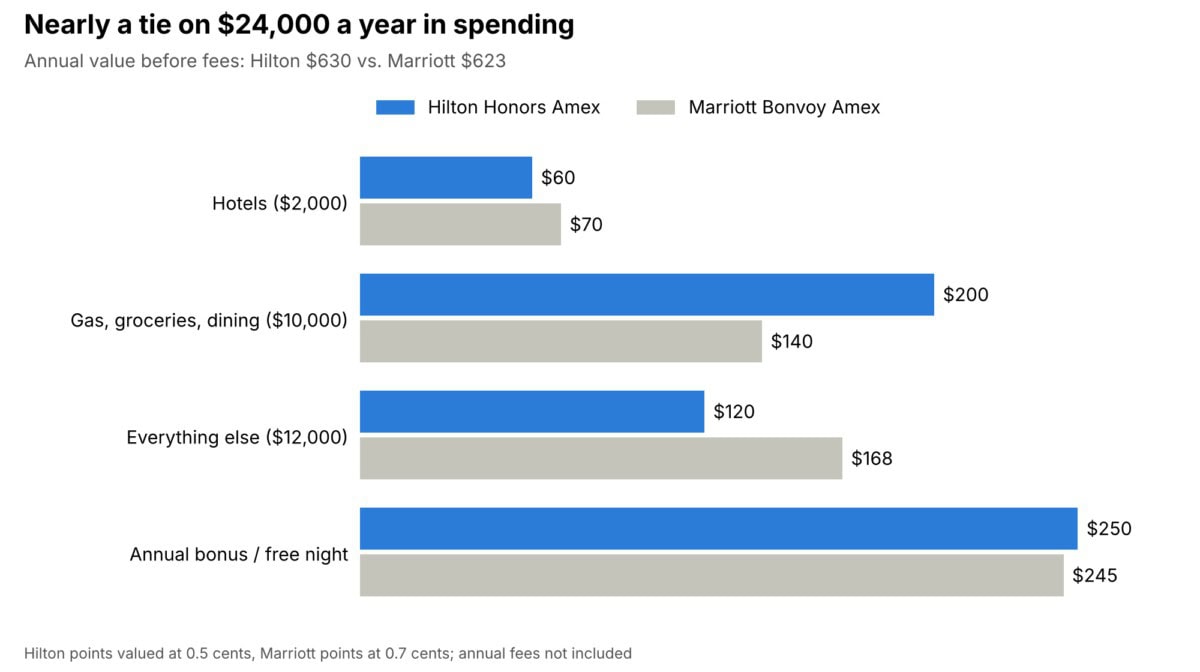
Leave the fees out, and you’d be hard-pressed to pick a winner. Factor them in, and Marriott comes out roughly $23 ahead. That gap is small enough to close quickly, though. For every $1,000 you move from general spending into groceries, gas or dining, Hilton gains $10 while Marriott’s return doesn’t budge.
The real deciding factor is the $12,000 threshold. Fall below it, and Hilton loses its $250 annual bonus, which makes Marriott the better card by a wide margin.
A missed opportunity on Membership Rewards
Amex Membership Rewards points still convert to Hilton Honors points at a 1:1 ratio. Given that a Membership Rewards point is worth at least one cent and a Hilton point is worth about half that, transferring is rarely a good use of your points.
It’s not like the Membership Rewards to Marriott Bonvoy transfer ratio of 1:1.2 is any better, bu there are regular 30% transfer bonuses to Marriott Bonvoy.
With Amex and Hilton now working together in Canada, it would have been a good time to sweeten that ratio. It hasn’t happened yet, so if you want Hilton points, the co-branded card remains the better way to earn them.
Is this card a fit for you?
If you travel often: Having status with a second hotel chain gives you more options when booking, and Gold status delivers breakfast or a dining credit without having to earn it through stays.
If your biggest expenses are food and gas: The 4x earn rate on gas, groceries and dining in Canada beats the Marriott card, and the advantage grows if your total spending reaches $12,000 a year.
If you put a lot on your card: Spending $40,000 a year unlocks Diamond status and lounge access, a level of status that’s rarely available through a Canadian credit card.
If you’re on the fence: The welcome bonus of up to 70,000 points plus a Free Night Reward, which isn’t capped by points on a standard room, makes it easy to test the card for a year and see whether Hilton suits your travel.
If you already have the Marriott card: Unless you’re loyal to Hilton or confident you’ll hit the $12,000 threshold, there’s no rush to make a change.
Final Thoughts
More competition in the hotel card space is a win for Canadians, and Hilton’s card brings real strengths. Gold status on day one is valuable, and the earn rate on everyday categories like groceries and dining is better than what Marriott offers.
But too much of the card’s value is locked behind spending targets. The annual bonus needs $12,000, Diamond needs $40,000, and the last 10,000 welcome points need you to keep the card into a second year. This isn’t new for Canadian credit cards, but it will impact the decision making of Canadians who are debating signing up for the card.
